
 Kev Caballero
 The simplest way to monitor where your Columbus business actually ranks on maps
The Simplest Way to Monitor Where Your Columbus Business Actually Ranks on Maps
If you are a business owner in Columbus, you’ve likely done it: you sit down at your desk in the Short North or your storefront in Worthington, pull up your phone, and search for your primary service. You see your business sitting pretty at the #1 spot in the Google Map Pack and breathe a sigh of relief. You think, “We’re winning.”
I hate to be the one to break it to you, but you’re likely falling into the “Proximity Trap.” Because you are physically standing at your place of business, Google’s algorithm – which prioritizes distance above almost everything else – is giving you a biased result. This isn’t what a potential customer in Bexley, Upper Arlington, or Gahanna sees. In fact, while you see yourself at #1, a customer just three miles away might see you at #15, buried deep behind your competitors. According to industry experts at Atomic Social, positive reviews are a primary driver for Map Pack visibility in 2025-2026, but even a five-star reputation can’t save you if you aren’t monitoring your reach across the entire city correctly. To truly dominate the local market, you need a strategy for google business profile seo that accounts for the fluid nature of local search.
Why Your “Rankings” Are a Lie: The Proximity Trap in Columbus
The biggest misconception in local SEO is the idea that your business has a single “rank.” In the world of organic desktop search, you might be #4 for “Columbus personal injury lawyer” across the state. But Google Maps doesn’t work that way. Maps rankings are hyper-local, often changing block by block. This phenomenon is what we call the proximity trap.
Imagine you run a plumbing company based in Clintonville. When you search from your office, you’re the king of the mountain. But as you drive south toward the Brewery District or north toward Lewis Center, your visibility drops off a cliff. Google’s goal is to provide the most convenient result to the user. If there is a competent plumber closer to the searcher, Google will almost always favor them, even if your profile is technically “better” optimized. You can learn more about this in our deep dive on The proximity trap: Why your Columbus store is losing local searches to shops further away.
To run a successful google maps ranking service for your own brand, you have to stop looking at a single data point. An authoritative ranking is not a number; it is a geographic footprint. If you aren’t tracking how your rank “bleeds” out from your center point into the surrounding Columbus suburbs, you are essentially flying blind. You might be losing thousands of dollars in potential leads from affluent neighborhoods simply because you didn’t realize your “reach” ended at the neighborhood line.
The “Simplest Way”: Visual GeoGrid Tracking
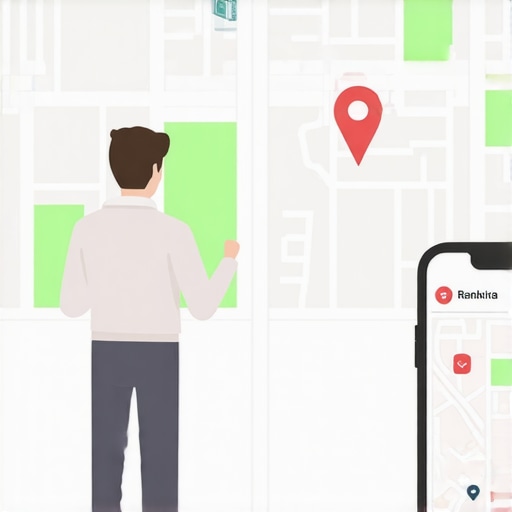
So, how do you see what your customers actually see? The answer isn’t driving around Franklin County with a laptop. The gold standard for modern local SEO is Visual GeoGrid Tracking. Instead of a list of keywords and numbers, a GeoGrid provides a literal map of Columbus with colored nodes (usually 1 through 20) plotted over specific coordinates.
When you use a google maps rank tracker, you aren’t just checking a keyword; you are running a simulation. The tool “pings” Google from hundreds of different GPS coordinates simultaneously. The result is a heat map. Green nodes (1, 2, or 3) mean you are in the Map Pack in that specific spot. Red or yellow nodes mean you are invisible to those residents. This is the most effective way to rank google business profile assets because it identifies exactly where your “authority” ends.
The workflow is remarkably simple:
- Enter Your Keyword: Choose a high-intent term like “emergency roofer Columbus.”
- Set Your Center Point: Usually your physical office or the center of your service area.
- Define the Grid: Choose a 5×5, 7×7, or 13×13 mile radius depending on how far you travel for work.
- Analyze the Heat Map: Look for patterns. Are you strong in the North but weak in the South? This tells you exactly where you need more local citations or localized content.
Using local seo tools that offer these visual grids transforms your strategy from guesswork to precision engineering. You stop worrying about the one guy who couldn’t find you and start focusing on the five square miles where you’ve inexplicably dropped to position #5.
Essential Tools for Monitoring Columbus Map Pack Ranks
Many business owners try to save money by manually searching in “Incognito Mode.” Let me be clear: Incognito mode does not hide your IP address or your physical location from Google. It is an unreliable way to track rankings. If you want to scale, you need automation. The “Local Business Rank Tracker” which integrates visual GeoGrids directly into manageable reports is the only way to stay competitive in a crowded market like Columbus.
When selecting a google business profile audit tool, you should look for features that go beyond just ranking. You need a tool that looks at your competitors’ grids as well. If you see a competitor dominating the Hilliard area, you can audit their profile to see what they are doing differently. Are they mentioning specific Columbus landmarks? Do they have more “local” photos? Richwood Marketing emphasizes that NAP (Name, Address, Phone) consistency across every directory is the foundation of Ohio map rankings, and a good tool will flag where your data is inconsistent.
By investing in professional-grade local seo ranking tools, you move away from the “hope and pray” method of marketing. You get weekly or monthly snapshots that show your progress. If you see your green circles expanding outward from downtown Columbus toward the outerbelt, you know your SEO efforts are working.
3 Metrics That Matter More Than Just “Rank”
While the visual grid is the most intuitive way to monitor your status, “rank” is still a vanity metric if it doesn’t lead to revenue. As a veteran in this space, I tell my clients to focus on these three specific KPIs:
- Share of Local Voice (SoLV): This represents the percentage of time your business appears in the top 3 spots across your entire tracked grid. If you have a 70% SoLV for “Columbus HVAC,” you are effectively the market leader.
- Average Map Rank: This is the mathematical average of all your grid points. It’s a great way to see if your overall “authority” is rising, even if you haven’t hit #1 in every single neighborhood yet. You can find more about interpreting these numbers in Why tracking local keywords is the only way to see your real Ohio reach.
- Conversion Actions: Google Business Profile (GBP) insights will show you calls, direction requests, and website clicks. Neil Colvin highlights that tracking real leads, not just clicks, is the only way to measure true local SEO success. If your rank is high but your calls are low, your profile might be “ranking” but not “selling.”
To understand the “why” behind these numbers, you should regularly review How to Read Google Maps Analytics to Find Your Best Columbus Customers. Tracking the data is only half the battle; interpreting the behavior of Columbus residents is where the profit is made.
Troubleshooting: Why Your Columbus Pin Isn’t Moving
You’ve started monitoring, you’ve got your GeoGrid, and… you’re stuck in a sea of red and orange. Why? Often, it comes down to technical debt or a lack of localized relevance. If your business is located in a basement in the Discovery District but you’re trying to rank in Dublin, you have a relevance gap.
One of the most common reasons for stagnation is NAP inconsistency. If your Yelp profile says “Street” and your GBP says “St.”, or worse, if you have an old phone number floating around on an old Yellow Pages listing, Google loses trust in your location. Furthermore, Neil Colvin highlights that separate service pages for each city/service are required to move the needle. If you want to rank in Grove City, you need a page on your site dedicated to “Grove City [Your Service].”
Another factor is your “Maps Embed” strategy. Many Columbus shops fail to properly link their physical location to their digital presence. Implementing The exact maps embed strategy that helps Columbus shops rank faster can provide the necessary “location signal” to push your grid nodes from yellow to green. If your storefront remains invisible, check out our guide on Why your Columbus storefront stays buried on the second page of maps to identify the specific technical hurdles holding you back.
Preparing for the 2026 Google Maps Algorithm Shift
The way we monitor rankings today will likely change by 2026. Google is moving toward an AI-first search experience (SGE). This means that instead of just showing the three closest shops, Google might show the shop that is “open now,” has the most reviews mentioning a specific niche product, and is currently trending in Columbus social media circles.
Proactive monitoring will involve tracking “conversational keywords” rather than just short-tail phrases. We are already seeing a shift where “best organic coffee Columbus” is being replaced by “where can I get a latte near me that is open after 8 PM.” To stay ahead, you must implement the Survival steps for the 2026 Google Business Profile algorithm shift. This includes optimizing for real-time signals and ensuring your visual tracking tools are updated to handle AI-driven local results.
Conclusion & Your Next Steps
Dominating the Columbus market requires more than just a “set it and forget it” attitude toward your Google Business Profile. You cannot improve what you do not measure. By moving away from biased manual searches and embracing visual GeoGrid tracking, you gain a massive competitive advantage over other local businesses that are still stuck in the proximity trap.
Monitoring is the first step to dominating. Once you see the gaps in your coverage, you can begin the hard work of building local citations, gathering reviews, and optimizing your on-page SEO. I highly recommend that you audit your profile using a professional google business profile audit tool today. Don’t let your competitors in the next zip code steal your customers simply because you didn’t know you weren’t showing up. Take control of your Columbus map rankings and turn your visual grid into a sea of green.