
 Kev Caballero
 Why Service Area Pages Are the Weakest Link in Your Ohio SEO Audit
As an Ohio business owner, you’ve likely experienced the “invisible wall.” You dominate the search results in your immediate zip code – perhaps right around your office in the Short North or your warehouse in Worthington – but the moment a potential customer searches from Dublin, Westerville, or Upper Arlington, your business is nowhere to be found. You’ve invested in a website, you’ve claimed your listing, yet you remain a ghost in the surrounding suburbs. This isn’t a fluke; it is the direct result of a failing local seo audit. In my years as a visibility consultant, I’ve found that Service Area Pages (SAPs) are almost always the weakest link in a brand’s digital chain. If you want to master google business profile seo in 2026, you have to stop treating your service areas as an afterthought and start treating them as the frontline of your local authority. There is a fundamental misunderstanding in the Ohio marketing landscape regarding the difference between a “Location Page” and a “Service Area Page.” A Location Page is designed for a physical office where customers are greeted – think of a med spa in Powell or a law firm in Downtown Columbus. A Service Area Page, however, is the lifeblood of the Service Area Business (SAB). These are the plumbers, roofers, and landscapers who travel to the customer. Because there is no physical storefront to verify proximity, Google’s algorithm is notoriously stricter with these listings. According to research from BrightLocal, SAPs often underperform compared to physical location pages because they lack the “bricks and mortar” trust signals that Google craves. When I perform a Why Your Google Business Listing Still Isn’t Showing Up for Local Searches analysis for a client, the first thing I look for is whether the website is trying to trick the algorithm or inform the user. In the 2026 search landscape, Google has moved beyond simple proximity. It now prioritizes “Proof of Presence.” If your website doesn’t prove you are actually working in Hilliard or New Albany, Google isn’t going to risk showing you in the Map Pack. This “identity crisis” often stems from Why Your Ohio Local SEO Strategy Fails the 2026 Mobility Test, where businesses fail to adapt their digital footprint to the mobile-first, location-fluid reality of modern search. For a decade, the “lazy” SEO strategy was simple: create 50 pages, change the city name in the H1, and call it a day. This “template-stuffing” approach is now a one-way ticket to a search penalty. In 2026, Google’s helpful content systems are sophisticated enough to recognize thin, repetitive content across subdomains. If your “Plumber in Lancaster” page is a carbon copy of your “Plumber in Pickerington” page, you are effectively telling Google that neither page provides unique value. To rank google business profile listings effectively, your on-page content must be as dynamic and localized as the services you provide. Integration between your google business profile seo and your SAPs is no longer optional; it is the baseline for survival. When I sit down with a Columbus business owner to review their digital presence, we often find that their service area pages are actually hurting their overall domain authority. Here are the three most common red flags we uncover during a professional audit. This is the most frequent offender. If you have a dropdown menu of 20 Ohio cities and every page features the same 500 words of text with only the city name swapped out, you are caught in the duplicate content trap. Google views this as a “doorway page” violation. Instead of seeing a helpful resource for a Hilliard resident, the algorithm sees a low-effort attempt to capture traffic. This is a primary reason why many How to Stop Ohio Local SEO From Ghosting Your Store in 2026 strategies fail; they prioritize quantity over the “Trust and Proof” metrics that the 2026 algorithm demands. Does your Westerville page mention the Otterbein University campus? Does your Easton-focused page reference the proximity to the 270 loop or specific landmarks like the Apple Store? If not, you are missing hyperlocal signals. Google’s AI now scans content for “entity relationships.” It knows that a legitimate business operating in a specific area will naturally mention local landmarks, neighborhood names, and even local weather patterns or soil conditions (relevant for contractors). Without these signals, your page is just a generic advertisement, not a local authority. Many businesses fail to connect their website’s service area pages back to their Google Business Profile. If you want to see real results, you should be utilizing a professional google maps ranking service to ensure that your digital coordinates match your service claims. A common mistake is failing to embed a customized Google Map on each SAP that highlights the specific service radius for that neighborhood. This creates a technical bridge between your website and the Map Pack, signaling to Google that your “Service Area” isn’t just a keyword – it’s a verified reality. Fixing your SAPs requires more than just better copywriting; it requires a technical overhaul. High-level local seo tools can help you identify where your schema is breaking or where your map embeds are failing to load. One of the most effective ways to boost your visibility is to implement a sophisticated The exact maps embed strategy that helps Columbus shops rank faster. This involves more than just pasting an iframe; it involves creating a map that reflects your actual service history in that specific suburb. Furthermore, your Schema markup must be airtight. You should be using `ServiceArea` and `LocalBusiness` schema on every SAP, but with a twist: you need to define the `areaServed` property using GeoJSON or specific zip code arrays. This gives Google’s crawlers a machine-readable map of where you operate. When combined with google business profile optimization, this technical foundation ensures that when a user in Dublin searches for your services, Google has a “verified” reason to place you in the top three results. Using GBP ranking tools allows you to monitor how these technical changes impact your “reach radius” in real-time, allowing for data-driven adjustments rather than guesswork. One of the biggest advantages a local Ohio small business has over a national franchise is the ability to be truly “local.” Big chains use centralized marketing teams that can’t tell the difference between Clintonville and German Village. You can. To rank higher on google maps, you must leverage this insider knowledge. I always tell my clients to include “Project Proof” on their SAPs. If you are a roofer in Upper Arlington, don’t just say you provide roofing. Show a photo of a job you completed near the Scioto Mile. Include a testimonial from a client who lives on Lane Avenue. Mention how the specific architecture of homes in that neighborhood influences your work. This is how How Columbus Exterminators Steal the Local Map Pack from Big Franchises – they provide a level of local context that a national brand simply cannot scale. This hyperlocal strategy proves to Google that you aren’t just “targeting” a city; you are active within it. It transforms your SAP from a weak link into a high-authority landing page that converts both search bots and human customers. Additionally, consider the “Community Connection” factor. Does your business sponsor a Little League team in Gahanna? Mention it on your Gahanna service page. Did you participate in the Dublin Irish Festival? Add a blog post about it and link it to your Dublin SAP. These are the “Prominence” signals that Google looks for when deciding which business deserves the coveted top spot in the local map pack. An audit is only the beginning. Once you have optimized your SAPs, you need to track your progress with precision. Standard SEO tools often provide a “global” rank that is useless for local businesses. You need a specialized google maps rank tracker that can show you your “heat map” of rankings across the entire Columbus metro area. This allows you to see exactly where that “invisible wall” is receding. Success in local search is measured by the expansion of your reach radius. If you previously only ranked in a 2-mile radius around your shop, and after optimizing your SAPs you now rank in a 10-mile radius that includes three new suburbs, you have won. Remember, google business profile optimization is an ongoing process. As competitors move in and Google updates its proximity filters, your SAPs must continue to evolve. For more advanced tactics, I recommend exploring Columbus SEO Strategies: Unlock Local Business Success in Ohio to stay ahead of the curve. Don’t forget to monitor your “Local Pack” insights within your GBP dashboard. Are you seeing an increase in “Request a Quote” or “Directions” from the specific suburbs you’ve targeted? If your SAPs are doing their job, you should see a direct correlation between on-page hyperlocal content and off-page conversion actions. If you’re still struggling, you might need to address Stop Hiding: 3 Fixes for Invisible Columbus Service Areas in 2026 to ensure your technical foundation is solid. In the competitive Ohio market, you cannot afford to have “ghost” pages that serve no purpose other than to take up space. Your Service Area Pages are either building your authority or eroding it. By moving away from thin, templated content and embracing a hyperlocal, technically sound approach, you can break through the invisible walls that limit your growth. Stop settling for a “near me” ranking and start aiming for a “everywhere in Ohio” presence. If your current strategy feels like it’s stuck in 2015, it’s time for a deep-dive. Perform a comprehensive audit of your SAPs today. If you need a partner to help navigate the complexities of the 2026 algorithm, reach out to me, Lyndsey McPherson, for a visibility consultation. And for the tools you need to automate your tracking and dominate the Map Pack, look no further than SEO Viper Tools. Your business deserves to be seen – make sure your website isn’t the thing standing in its way. For more insights on dominating the Buckeye State’s search results, check out our guide on Google Maps Ohio: How to Dominate Local Search Rankings.Why Service Area Pages Are the Weakest Link in Your Ohio SEO Audit
The “Identity Crisis” of Ohio Service Area Pages
Why Standard “City Pages” Are Failing in 2026
3 Audit Red Flags: Is Your SAP Sabotaging Your Rank?
1. The “Duplicate Content” Trap
2. Lack of Hyperlocal Signals
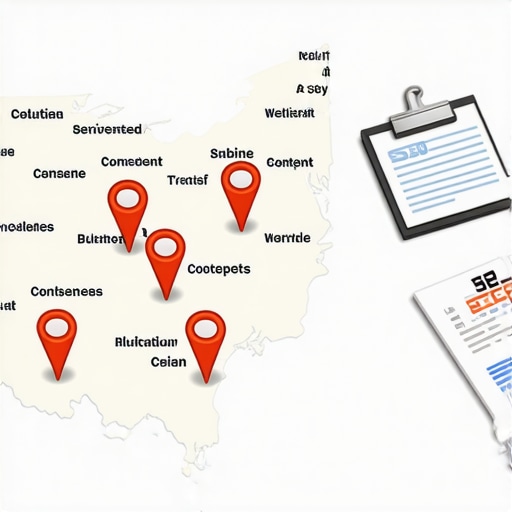
3. The Missing Map Connection
The Technical Fix: Schema, Embeds, and Authority
Hyperlocal Content: How to Outsmart Big Chains in Ohio
Measuring Success Beyond the Audit
Conclusion: Don’t Let a Weak Link Break Your Ohio Growth